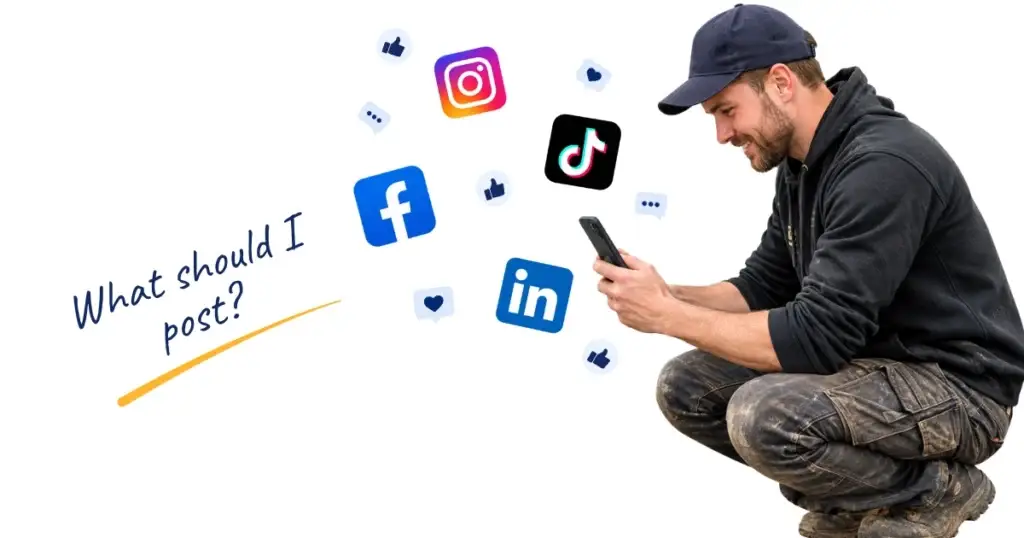
If you’re running a trade business, social media can feel like another job you’re supposed to somehow find time for.
Facebook wants posts. Instagram wants photos and Reels. TikTok wants videos. Then there’s LinkedIn, and you’ve probably been told you should be posting on your Google Business Profile too.
Meanwhile, you’ve got actual jobs to get done.
The good news is you don’t need to be everywhere, you don’t need thousands of followers and you definitely don’t need to turn yourself into a full-time content creator.
Social media can be much simpler than that.
For most tradespeople, it’s another way to show potential customers that you’re a real, active business doing good work. They can see the jobs you’ve completed, the areas you work in, what your customers think of you and the person or team behind the business.
The trick is choosing the places that make sense for the type of work you want, rather than trying to keep every social media account alive.
You don’t need to be on every social media platform
There’s no single social media platform that every trade business needs to use.
A landscaper doing garden transformations for homeowners has very different work to show than an electrician trying to win commercial contracts. The platforms that make sense for one won’t necessarily make sense for the other.
A good starting point is to think about who you want to find you and what you can realistically keep up with.
If you mainly work for homeowners in your local area, Facebook is worth considering, particularly if there are active community groups covering the areas you work in.
If your work is very visual, Instagram gives you somewhere to build up a portfolio of finished jobs, before and afters and short videos.
If you’re happy making videos and regularly find yourself answering the same customer questions, TikTok or Instagram Reels could be worth trying.
If you’re looking for commercial contracts and want to build relationships with builders, developers, landlords, facilities managers or other businesses, LinkedIn starts to make more sense.
And then there’s your Google Business Profile. It isn’t actually social media, but it deserves a place in this article because it’s another part of what potential customers can find when they’re checking out your business.
You don’t have to pick all of them.
In fact, you’re probably better off choosing one or two that suit your business and actually using them than creating five profiles that haven’t been updated since 2023.
Facebook for tradespeople
Facebook can be useful for local trade businesses because it gives you plenty of ways to show people what you’re doing.
You don’t need particularly clever posts either.
Finished a bathroom in Chester? Show it.
Cleaned a driveway in Shrewsbury that looks completely different now? Get a before and after.
Rewired a property in Worcester? Share a couple of photos and briefly explain what you did.
Received a great review from a customer? Share it.
These posts aren’t just about getting likes. Over time, they give someone looking at your page a much better idea of the work you do and whether you’re active in their area.
Don’t forget local Facebook groups
Local groups can be particularly useful, but that doesn’t mean posting the same advert into every community group you can find.
Pay attention to the conversations happening in them.
Someone asking:
“Can anyone recommend a reliable plumber in Manchester?”
is already looking for the service.
That’s a much better opportunity to respond helpfully than repeatedly dropping an advert into the group hoping somebody happens to need a plumber that day.
If the group’s rules allow businesses to post, you can still share your work occasionally. A recent job with a few decent photos and some useful information is usually a lot more interesting than another generic “Call now for a free quote” graphic.
The aim isn’t to make your local Facebook group sick of the sight of you. It’s to be visible when your work is relevant.
Instagram can become your portfolio
Instagram makes a lot of sense for trades where the finished result is something people want to see.
Landscaping, decorating, tiling, bathrooms, kitchens, plastering, exterior cleaning and similar work naturally gives you plenty of visual content.
Think of your Instagram profile as a growing portfolio rather than something you need to become famous on.
Before and after photos are an obvious choice, but don’t stop there. Show finished work, interesting details, jobs in progress and short videos walking through the end result.
Reels don’t need a complicated script either.
A few short clips from different stages of a job can be enough. You could show what you started with, a bit of the work being done and the finished result.
Stories can be even less polished.
If you’re halfway through a job and there’s something interesting to show, take your phone out and show it. It doesn’t need editing, captions flying across the screen and dramatic music.
You’re showing people what you actually do for a living.
That’s the useful bit.
TikTok without becoming a TikToker
TikTok can put a lot of tradespeople off because they picture dancing, trends and spending hours making videos.
You don’t have to do any of that.
Some of the most obvious video ideas are probably questions your customers already ask you.
Why does my boiler keep losing pressure?
How much does it cost to replace a consumer unit?
Why does my drain keep blocking?
Can you paint over this?
Why has my patio gone green again?
You already know the answers because you deal with these things every week.
Interesting things you find on jobs can make useful videos too. If you uncover the reason a problem keeps happening, explain it. If something needs replacing rather than repairing, explain why. If there’s a big difference between a cheap option and a more expensive one, explain what the customer is actually paying for.
You don’t need a studio. Your phone and 30 seconds can be enough.
There is one trap worth watching though.
Who are your videos actually for?
It’s quite easy for trade content to start attracting other tradespeople.
They’ll comment on tools, debate how you’ve done the job and tell you exactly how they’d have done it differently. Because, well… it’s the internet.
You might also attract lots of people looking for DIY instructions.
There’s nothing wrong with either audience if that’s what you want. But if your goal is to find paying customers, keep asking yourself who you’re making the content for.
A heating engineer could make a highly technical video that another heating engineer finds fascinating.
Or they could make a video answering:
“Why does my boiler pressure keep dropping?”
The second one is much closer to the question their potential customer is typing into their phone.
You don’t need every video to get thousands of views. You need the right people to understand that you know what you’re doing.
Don’t get too hung up on followers and views
It’s very easy to judge whether social media is working by looking at the numbers the platform puts in front of you.
Followers. Likes. Views. Shares.
They’re nice to have, but they don’t automatically mean more work.
A TikTok video could get 50,000 views from people all over the country and never produce a single useful enquiry.
A Facebook post might only be seen by a few hundred people, but if some of those people live in the area you work in and one needs your service, that’s potentially far more useful.
There’s another side to this too.
Not everyone who looks at your social media found you there in the first place.
Someone might find you on Google, look at your reviews, visit your website and then have a quick nose at your Facebook page before they contact you.
They’re looking for reassurance.
Are you still trading? What sort of work do you do? Does your work look good? Do you work around here? Do other customers seem happy?
So don’t judge everything by how many likes Tuesday’s post got.
Pay attention to the things that matter to the business: genuine enquiries, website visits, calls, messages and customers mentioning that they’ve seen your work online.
Your Google Business Profile deserves some attention too
Your Google Business Profile isn’t technically social media, but if you’re a local trade business, it’s an important part of your online presence.
It’s what can appear when somebody searches for your business on Google, and it can also help Google understand what your business does and where it operates.
Start with the basics.
Make sure your business information is accurate. Your phone number and website should work. Your services should reflect what you actually offer.
Then add real photos from recent jobs.
They don’t all need to be professional photos. Clear, genuine photos of your work can give potential customers a much better idea of what you do.
Reviews matter too. Ask customers to leave them and take the time to reply when they do.
You can also publish updates through your Google Business Profile, but don’t fall into the trap of thinking that posting every Tuesday at 7pm is some secret trick that’ll suddenly shoot you to the top of Google.
There isn’t a magic posting schedule.
Keep the profile useful, accurate and representative of the business customers will actually get when they contact you.
If you’re not sure whether your profile is set up properly, you can also take a look at my Google Business Profile optimisation service to see what I can help with.
Is LinkedIn worth bothering with?
For plenty of domestic tradespeople, LinkedIn probably doesn’t need to be high on the list.
If most of your customers are homeowners looking for someone to tile a bathroom, fix a boiler or clean a driveway, there are probably better places to spend your time.
It becomes much more interesting if you’re trying to win commercial work.
Builders, developers, landlords, letting agents, facilities managers, property companies and other businesses use LinkedIn too.
In that case, your content can look a little different.
You might share larger completed projects, commercial jobs, new contracts, accreditations, case studies or examples of problems you’ve solved for other businesses.
You can also connect with the types of people and businesses you’d genuinely like to work with.
If commercial work isn’t something you’re chasing, don’t create another social media account just because you feel like you’re supposed to have one.
So, where should you concentrate your time?
If you’re still wondering where to start, think about the type of customer you actually want.
You mainly work for local homeowners
Facebook and your Google Business Profile are sensible places to concentrate your attention.
Your work is very visual
Instagram gives you somewhere to build a strong portfolio of your work. Facebook may also be useful for reaching people locally.
You’re comfortable making short videos
Try TikTok or Instagram Reels. Start with questions customers regularly ask rather than worrying about trends.
You want more commercial or B2B work
LinkedIn may deserve more of your time, particularly if the people who commission the work you’re after are active there.
You can pick two.
You can even pick one and do it properly.
There’s no prize for maintaining the largest collection of neglected social media accounts.
Stop trying to invent content
One of the biggest reasons tradespeople struggle to post regularly is because they think they need to keep coming up with new ideas.
You don’t.
You’re walking into potential content every time you start another job.
Take a photo before you begin.
Take another while you’re working.
Photograph anything unusual or interesting you find.
Get a decent photo when you’re finished.
Maybe take a 10-second video too.
One job could give you a before and after for Facebook, a finished photo for Instagram, a short video for TikTok or Reels and another real job photo for your Google Business Profile.
You haven’t had to invent any of it. You just remembered to photograph the work you were already doing.
If remembering which photos to take is the problem, I’ve put together a free Job Photo Checklist for Trades that you can save and use on your next few jobs.
After a while, you’ll have a bank of genuine photos and videos to choose from instead of getting to Friday afternoon and realising you haven’t got a clue what to post.
Social media is only one part of the picture
Getting someone to notice your business is one thing. Getting them to actually contact you is another.
People don’t always follow a neat route.
They might see your name recommended in a Facebook group and then Google you.
They might find your Google Business Profile and visit your website.
They might see one of your videos, look at your reviews and come back three weeks later when they’re ready to get the job done.
That’s why it’s worth looking at the whole picture rather than expecting one social media platform to do everything.
Your social media can show what you’re doing. Your reviews can show what previous customers think. Your Google Business Profile can help people find and check your business. Your website gives them somewhere to properly see your services, the areas you cover and how to contact you.
If you haven’t looked at your own website for a while, I’ve also made a free 7-Point Website Check for Trades. It takes you through seven simple things to check from a potential customer’s point of view.
Start with your next job
Don’t go away from this and make yourself a 12-month social media content calendar.
Just start with your next good job.
Take a photo before you start, another while you’re working and a decent one when you’re finished. Get a short video if there’s something worth showing and make a note of the problem you solved.
That’s enough.
Do it again on the next job, and the one after that.
Before long, you’ll have something far more useful than a folder full of Canva adverts: real examples of the work your customers actually pay you to do.