
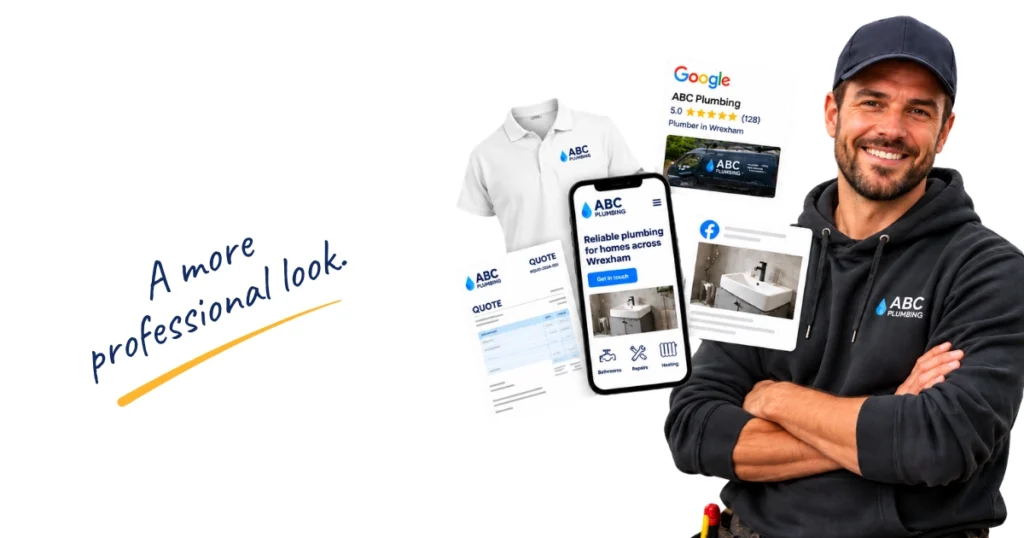
You don’t need a fancy logo, a fleet of matching vans or a marketing department to make your trade business look professional.
Most of it comes down to getting the small things right.
A customer might find you on Google, look at a few photos of your work, visit your website, check your Facebook page and then ask for a quote. Later, they might see your van parked outside or receive an invoice from you.
Each one gives them a little more information about the business they’re dealing with.
If your business name changes slightly from one place to another, your Facebook page hasn’t been updated for two years, your quote is difficult to read and your website barely works on a phone, it can make the whole thing feel a bit thrown together.
The good news is you don’t need to rebrand the entire business to fix it.
A few fairly small changes can make a big difference to how professional your business looks.
Looking professional doesn’t mean looking like a big company
If you’re a sole trader, there’s nothing wrong with looking like a sole trader.
You don’t need to make the business look as though there are 25 people sitting in an office somewhere when it’s actually you, your van and perhaps an apprentice.
Customers aren’t necessarily looking for a huge company. They’re looking for signs that the person they’re considering is genuine, organised and takes their work seriously.
That can be as straightforward as having:
- clear business information
- decent photos of your work
- a professional-looking quote
- up-to-date contact details
- clean workwear
- a website that works properly
- reviews from real customers
- the same business name and logo wherever they find you
Think tidy and consistent, rather than corporate.
Start with your business name, logo and colours
You really don’t need to make this complicated.
If you already have a business name and logo that you’re happy with, there’s no reason to change them just because somebody on the internet told you that you need a new “brand identity”.
Your logo mainly needs to be clear and readable.
Think about all the places you’re likely to use it. It might appear across the side of a van, embroidered onto a polo shirt, at the top of an invoice and as a tiny profile picture on Facebook.
If it only works when it’s enormous, that’s going to cause problems.
The same goes for colours. Pick a small number that work well together and use them consistently. You don’t need to get into the psychology of whether blue makes people trust plumbers more than green does.
Just make sure everything is easy to read.
Bright yellow writing on a white background might technically match your van, but nobody should need sunglasses and a magnifying glass to read your phone number.
Make sure your van tells people what you actually do
Your van can be seen by hundreds of people while you’re driving around or parked outside a job.
It doesn’t need to tell them your life story.
Someone looking at it should be able to work out fairly quickly:
Who are you?
What do you do?
How can they find or contact you?
Your business name should be easy to read and your trade or main service should be obvious.
Then give people a clear way to find you, such as your website or phone number.
You probably don’t need to list every service you’ve offered since 2007 down the side.
If you’re a plumber offering bathrooms, boiler work, heating repairs, servicing, cylinders, radiators, taps, showers, leaks and 14 other things, you don’t need all 22 squeezed onto the van.
“Plumbing & Heating” tells people quite a lot.
The same applies to the design itself. A little empty space isn’t wasted space. If someone needs to sit behind you through three sets of traffic lights to decipher the van, there’s probably too much going on.
Don’t overlook your workwear
Workwear is another fairly easy win.
It doesn’t need to be expensive and you certainly don’t need a wardrobe full of branded clothing.
Clean, reasonably consistent workwear with your business name or logo can make even a very small business look established.
It also helps when you arrive at someone’s home. They’ve booked ABC Electrical and someone wearing an ABC Electrical polo has just knocked on the door. There’s no confusion about who you are.
Obviously, you’re doing physical work. Nobody expects a landscaper who’s spent six hours digging out a garden to look freshly ironed by 4pm.
There’s a difference between looking like you’ve been working and looking like you’ve been sleeping in the van.
Use an email address that belongs to the business
If you have your own domain name, it’s worth using it for your email too.
Something like:
info@yourbusiness.co.uk
usually looks neater than an old personal email address you created years ago.
That doesn’t mean customers will refuse to hire an excellent electrician because their quote came from Gmail. Plenty of good trade businesses use Gmail and get plenty of work.
It’s just another small detail that can make the business feel a little more joined up, particularly if you already have a website using the same domain.
Whatever email address you use, make sure it’s one you actually check.
A beautiful business email isn’t particularly useful if customer enquiries disappear into it for six days.
Make your quotes and invoices easy to understand
This is one of those areas that’s easy to overlook because you see your own paperwork all the time.
Your customer doesn’t.
They might have spoken to you on the phone, looked at your website and then received your quote. It should feel as though all three came from the same business.
You don’t need an elaborate quote template.
Include your business name, contact information and logo if you have one. Lay everything out clearly. Explain what the customer is getting and make the price easy to understand.
Check the spelling too.
The same goes for invoices, receipts and any other documents you regularly send.
You can also look at the actual wording you use.
Rather than filling paperwork with technical terms a homeowner may not understand, explain things in normal language wherever you can.
Customers shouldn’t have to ring you to work out what half the quote means.
Google your own business
Seriously. Do it.
Search your business name as though you were a potential customer who had just been given your details.
What comes up?
For many tradespeople, one of the first things a customer will see is their Google Business Profile.
Check that the basics are right.
Is the phone number current? Does the website link work? Are the opening hours sensible? Is the business name correct?
Then look at the photos.
A Google profile with real, recent photos of completed work gives someone far more to go on than a profile containing a logo, a picture of the van from 2019 and nothing else.
Reviews help here too. They give potential customers an idea of what previous customers experienced, rather than relying entirely on what the business says about itself.
Your Google profile doesn’t need to look like it’s being managed by an agency.
It just needs to look like the business is real, active and still doing good work.
Take better photos of your work
This is probably one of the biggest improvements many trade businesses can make without spending anything.
If you’re good at what you do, show people.
A landscaper can show the garden before and after the job. A tiler can show the finished bathroom. An electrician can show a neat consumer unit installation. A decorator can show the transformation of a room.
Those photos can then be used on your website, Google Business Profile and social media.
You don’t need a professional photographer following you around.
Modern phones are more than capable of taking good job photos. The biggest difference usually comes from slowing down for a minute before taking them.
- Wipe the camera lens.
- Turn the lights on.
- Open the blinds if the room is dark.
- Move obvious rubbish and tools out of the finished shot where practical.
- Take a few different angles.
- And make sure you get the photo before you leave.
That last one catches people out. You finish a job you’re really proud of, pack everything into the van, drive home and then realise you didn’t take a single decent photo.
Before and after photos are particularly useful because customers can see the difference your work has made.
Try to avoid relying on screenshots, heavily filtered images or generic stock photos when you’ve got real work you could show instead.
If getting decent job photos is something you keep forgetting, I’ve made a free Job Photo Checklist for Trades that you can save to your phone and use on your next few jobs.
After a while, you’ll build up a useful bank of real photos without having to go hunting for them every time you want to update your website or post something online.
Keep your social media recognisable
Your Facebook or Instagram page doesn’t need to look like you’ve hired a social media agency.
For most small trade businesses, showing that you’re active and doing real work is a good place to start.
Use the same business name and logo people will see elsewhere. Make sure your contact details are correct and check that any links in your profile still work.
Then show some jobs.
A quick post with a few decent photos and a short explanation of what you’ve done can tell a potential customer quite a lot.
You don’t need to turn every post into a carefully designed graphic.
In fact, if someone is trying to decide whether they want you to tile their bathroom, photos of bathrooms you’ve actually tiled are probably more useful than a graphic telling them it’s Tuesday.
Look at your website on your phone
Don’t just look at it on the computer you normally use.
Get your phone out and visit your website as though you’d never seen the business before.
Within a few seconds, can you work out:
- what the business does?
- where you work?
- how to contact you?
- what your work looks like?
- whether other customers have been happy with you?
Then try using it.
Can you read the text without zooming in?
Do the buttons work?
Can you easily find the phone number?
Are the photos clear?
Is anything overlapping, disappearing off the screen or obviously broken?
Check the information itself too. If the website says you’ve been trading for eight years because that’s what you wrote when it was built four years ago, it’s time for an update.
Your website doesn’t need animations flying across the screen or pages full of marketing waffle.
It needs to give a potential customer the information they’re looking for and make it easy to take the next step.
If you’re not sure where to start, use my free 7-Point Website Check for Trades. It’ll help you look at your website from a customer’s point of view and spot some of the things that might need sorting.
And if the problem is bigger than a few changes, PipeDream Digital builds affordable websites for tradespeople too. So if your current website is dated, difficult to use or just doesn’t represent the standard of work you do anymore, you can see the website options here.
Make sure it all looks like the same business
This is the bit that ties everything together.
Imagine someone spots your van outside their neighbour’s house.
They remember the business name and Google you later.
They find your Google profile, visit your website and look through a few jobs. They message you and eventually receive a quote.
Nothing there needs to be spectacular.
But it should all feel like they’ve been dealing with the same business.
- Use the same business name.
- Use the same logo.
- Stick roughly to the same colours.
- Keep your phone number, email address and website details consistent.
- Use decent photos of your actual work.
- Keep the general standard of presentation similar.
That’s really what a lot of “branding” comes down to for a small trade business.
You don’t need a 30-page document telling you precisely how many millimetres of empty space should surround your logo.
You need customers to move from one part of your business to another without wondering whether they’ve found the right company.
Give your business a five-minute customer check
Before you start ordering new workwear or redesigning your van, spend five minutes looking at what you’ve already got.
→ Google your business.
→ Look at your van.
→ Open your Facebook page.
→ Visit your website on your phone.
→ Find the last quote you sent.
→ Look through the last five job photos you took.
→ Now pretend you know absolutely nothing about the business.
Does it all look like the same professional company?
You’ll probably spot a few things straight away.
Don’t make yourself a list of 47 jobs and decide the whole business needs rebranding by Monday.
Pick the three things that let you down most.
Maybe your Facebook profile still has an old phone number. Maybe your quotes need tidying up. Maybe you need to start taking better photos before you leave jobs.
Sort those first.
Then keep going.
Looking professional usually isn’t the result of one huge change. It’s what happens when all those little bits of the business start looking like someone cares about them.